
White Palace
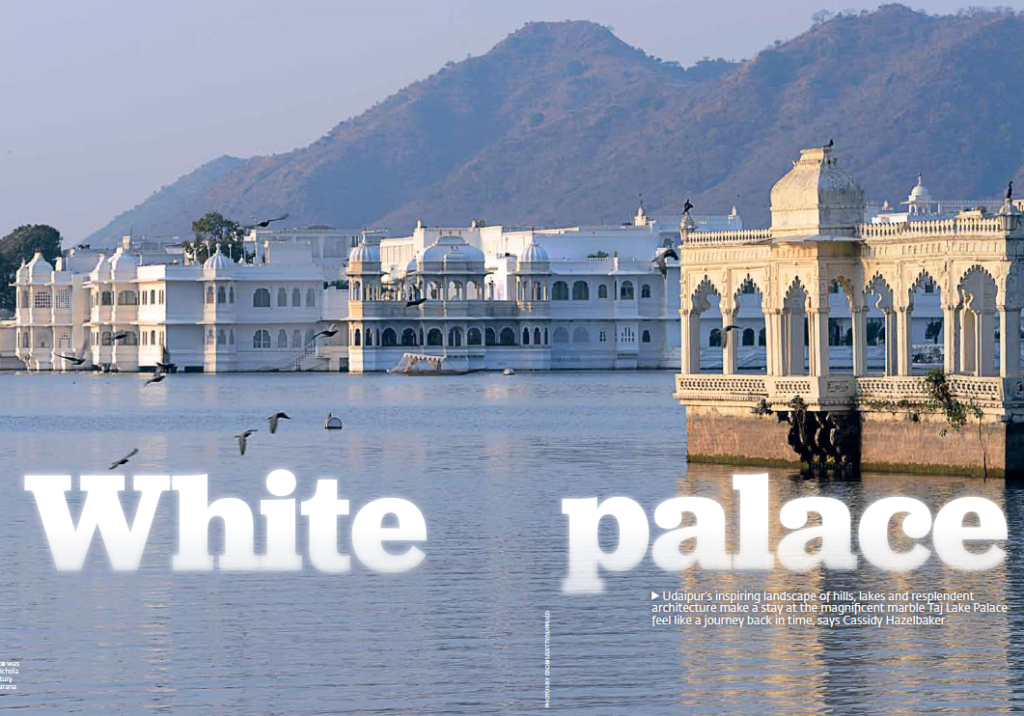
Udaipur’s inspiring landscape of hills, lakes and resplendent architecture make a stay at the magnificent marble Taj Lake Palace feel like a journey back in time, says Cassidy Hazelbaker
After a nine-hour, cramped, dusty car ride from Jaipur to Udaipur in Rajasthan, the sight of the gleaming wrought-iron gates of the Taj Lake Palace’s boat dock is an extremely welcome one.
The luxury experience begins straight away as I’m greeted with refreshments at the dock, before a five-minute speedboat ride provides a glimpse of the most fabulous sights of Udaipur: the City Palace on the banks of the lake, the Monsoon Palace sitting majestically on a distant hill and, finally, the royal ‘floating’ paradise that is the Taj Lake Palace.
This luminous 18th-century marble vision, built on Lake Pichola by Prince Maharana Jagat Singh II, is truly a destination in itself.
My late-afternoon arrival coincides with the sunset, at which time the last of the sun’s rays bring about a glimmering pearly glow from the palace’s white marble facade.
The lake is calm and still as we approach the island; we seem to be the only thing moving on the glassy water. Such tranquillity gives me the impression that time is standing still, or that I’m traversing the centuries to a destination in a bygone era.
This sensation persists as I alight at the palace’s dock to find a flurry of movement – hundreds of red rose petals cascade around me, seemingly fluttering from the sky. This floral shower is a traditional royal Rajasthani greeting, I’m informed by a hostess adorned in a beautiful red and gold sari. She dips the tip of her finger into a small pot of vermilion powder and expertly applies a bindi to my forehead for prosperity and wisdom. After such a ritual, I feel I have truly arrived.
Built between 1743 and 1746 on a four-acre natural rock formation at one end of Lake Pichola as a summer palace, the Taj Lake Palace – or Jag Niwas, as it was formerly known – was transformed into a hotel in 1963.
The palace is an exquisite example of Rajput architecture. Ornately carved marble archways and gilded domes grace the exterior, while colonnaded corridors surround a lily pond in the interior of the palace.
I pass through these grand corridors as I’m escorted to my room, feeling as close to a queen as I’m ever likely to get. I open the door in delight, finding a colourful and luxurious interior awaiting me. A huge white bed takes centre stage, standing out from the peach-coloured wall panels and echoing the white lustre of the tiered marble crown moulding. Antique wall fixtures and a stately wooden chest complete the room and reinforce the prevalent influence of past eras.
As decadent as I find my room, I can’t contain my curiosity to see what else the palace has to offer, so I head back out to prowl around the property.
The palace is composed of several floors with vast rooftop terraces. One, with an expansive view over the City Palace, is set for a private dinner. Hundreds of lanterns illuminate the black-and-white marble of the venue, as the shadows of the candle flames dance in the breeze. A gazebo covered with a blossoming bougainvillea vine makes a whimsical and beautiful spot for post-dinner stargazing.
With such enchanting spaces sprinkled throughout the property, it’s no wonder Taj Lake Palace has been voted one of the most romantic hotels in the world.
After so much exploring I’ve worked up an appetite, so I head to Neel Kamal, the hotel’s Indian restaurant. Live classical sitar music sets the ambiance and the restaurant’s decor is fit for a king.
A feast of daal makkhani, lamb kebabs, buttery parathas, curried vegetables and basmati rice ensues. Warm gulab jamun, delicately flavoured with cardamom and rosewater, complete the meal.
The Amrit Sagar bar next to the restaurant is a lovely venue in which to have an after-dinner drink or just to admire the decor of the palace, with views on to the interior courtyard in which daily traditional Rajasthani dances are performed.
The next morning I spend a little time poolside enjoying the view on the lake, which is mere metres away. An attentive steward provides chilled water, refreshing hand towels, an Ayurvedic rose facial toning spray and cucumber slices to soothe my eyes.
A unique feature of the Taj Lake Palace’s pool area is the elevated jacuzzi, which is contained within a small gazebo suspended over the water and allows guests to soak while seemingly floating in the lake.
Palaces of the past
Tempting as it is to stay within the blissful luxury of the hotel, I venture out to see the famed sights of the Venice of the East.
Back on shore on the east bank of Lake Pichola, the City Palace is just a few minutes away from the Taj Lake Palace’s dock. I amble up a hill to view the extensive complex, which constitutes the City Palace.
Built in 1559 by Maharana Udai Singh, the colossal structure fuses Rajput and Mughal architecture and is the largest royal complex in Rajasthan. In accordance with the sun-worshipping customs of the maharana, it faces East. The interior of the palace is a maze of rooms large and small, narrow corridors and staircases. Beautiful decorative tiles and objects populate some rooms, while others are set up to offer various historical titbits.
Large windows from the top floor offer panoramic views of the urban sprawl of Udaipur – a stark contrast to the spacious luxury of the palaces of the past.
The Monsoon Palace, made famous in recent history by the James Bond film Octopussy, is a striking structure high above Udaipur in the Aravalli hills. Originally known as Sajjan Garh Palace, it was built in 1884 and used to track the monsoon clouds, from which the current name is derived.
Jutting above the city, sweeping views of Udaipur’s lakes and lush countryside can be had from the palace’s grounds. I can only imagine the anticipation felt by those on lower ground, waiting for the monsoon predictions.
The palace is no longer used for any royal functions, but instead houses a wilderness-themed exhibition from a local forestry unit.
The most fascinating of the plethora of temples in Udaipur is the Indo-Aryan Jagdish Temple. Built by Maharana Jagat Singh and completed in 1651, the tall cone-shaped building is fantastically carved with images of elephants, horses, tigers, priests and elaborate artistic patterns.
The gleaming sand-coloured structure raises defiantly into the blue Rajasthani sky, a testament to the strength and resilience of the local people and their craftsmanship.
The temple is dedicated to Lakshmi, Hindu deity of wealth, prosperity and fortune, and worshippers come regularly to offer their prayers and take a blessing from the resident Hindu priest. A steady stream of barefoot worshippers and tourists circle around the temple, awestruck by the intricate details that decorate its exterior.
An evening to remember
On my last night in Udaipur I opt to try the sunset cruise organized by the Taj Lake Palace. Boarding the sleek speedboat, I stare wide-eyed at the vivid colours painting the sky. The most radiant shades of pink and orange look like a work of art painted on an artist’s canvas. The white marble of the City Palace and the Lake Palace glow mesmerizingly against such a colourful background.
The boat tour takes us near the banks, where we observe people bathing, swimming and socializing in and around the water. Private havelis (mansions) converted into hotels line the banks, their rooftop restaurants packed with diners soaking up the evening sun in this exotic and wonderful land.
Our boat approaches Jag Mandir, a marble structure protruding from the lake’s surface. A row of life-size marble elephants line the perimeter of the island, which our guide explains is a freestanding island similar to the Taj Lake Palace’s foundation.
Built between the mid-16th and 17th centuries, the palace has been used for a variety of purposes throughout its history; notably to provide refuge to Prince Khurram, who had rebelled against his father, Emperor Jahangir, in 1623.
Today the palace grounds comprise a large courtyard, fountain and garden areas, a few hotel rooms and a restaurant. Bathed in a warm yellow glow from strategically placed spotlights, the palace shimmers in the water like a star in the night sky.
Cruising back to the Taj Lake Palace as darkness falls, I review my stay in this magical lake city. The captain points out a red light on one of the City Palace’s towers. The light signals to Udaipur residents that the maharana is in the city. Of all the magnificent places in India, I muse, what a splendid one to call home.